

FRP Tank Inspection and Preventive Maintenance Checklist
A buyer's guide to inspecting FRP tanks in corrosive service — external and internal checks, Barcol hardness baselines, inspection intervals, and the ASTM standards that define acceptance criteria.
FRP Tank Inspection and Preventive Maintenance Checklist
An FRP tank that was specified correctly and built to the right standard will outlast most of the equipment around it. The failures that show up in the field rarely trace back to the laminate being wrong on day one. They trace back to a vessel nobody looked at for eight years, where a soft spot in the corrosion barrier gets discovered the week a shutdown ends and the replacement lead time is measured in months.
This guide covers what to inspect on an FRP tank in corrosive service, what the findings actually mean, how to set inspection intervals, and which ASTM standards give you defensible acceptance criteria. It is written for the people who own the asset: plant engineers, maintenance planners, and the buyers who have to justify the budget.
Why Preventive Inspection Pays for Itself
FRP degrades from the inside out. That single fact drives everything about how these vessels should be managed. The process fluid attacks the interior corrosion barrier first, and by the time evidence reaches the outside wall, the damage has already moved into the structural laminate.
- Damage that is still confined to the corrosion barrier can usually be repaired in place. Damage that has reached the structural plies often cannot.
- Industrial FRP tanks are engineered and fabricated to order. Replacement lead times do not compress because you discovered the problem late.
- In acid, caustic, or process-water service, a leak is not just a production issue; it is a containment and permitting event.
- Documented condition data lets you schedule repair work into a planned outage instead of reacting to an unplanned one.
- Inspection records also protect the warranty conversation. A vessel with no maintenance history is difficult to defend on either side.
What Actually Degrades in an FRP Tank
Both ASTM D3299 (filament-wound tanks) and ASTM D4097 (contact-molded tanks) describe FRP construction as two functionally distinct regions: a resin-rich interior corrosion barrier, built from a surfacing veil backed by chopped-strand reinforcement, and the structural laminate behind it that carries hydrostatic, wind, and seismic loads. Inspection is mostly the work of confirming that the barrier is still doing its job.
- Chemical attack on the resin matrix, showing up as softening, discoloration, or blistering of the inner surface
- Fiber prominence or exposed glass, meaning barrier resin has eroded and the fluid can now wick along the fibers
- Crazing and cracking driven by thermal cycling, fill and draw cycles, agitation, or vibration from connected equipment
- Mechanical damage from metal tools, impact during cleaning, or equipment dropped during entry work
- Abrasion from suspended solids, which concentrates at inlet impingement points and in agitated zones
- Stress at nozzles and joints caused by piping loads the nozzle was never designed to carry, or by thermal expansion of connected steel
- UV degradation on outdoor exteriors where no UV-inhibited coating or gel coat was specified or maintained
- Liner bond loss, blistering, or permeation on fluoropolymer-lined equipment
External Inspection: What You Can Do Without Entry
The external walk-down needs no permits and no downtime, and it catches a surprising share of developing problems. It should be a routine round, not an event.
- Exterior surface condition: chalking, fiber blooming, and surface crazing, which indicate the exterior resin is weathering
- Cracks at high-stress geometry: nozzle penetrations, the bottom knuckle radius, lifting lugs, and ladder or platform attachments
- Weeping, staining, or crystalline deposits at seams, joint overlays, and nozzle bases, which are the first external evidence of fluid migration through the wall
- Vent path: confirm the vent is open and unobstructed. A plugged vent on an atmospheric tank can collapse the vessel on draw-down or overpressure it on fill, and it remains one of the most common and most destructive findings in the field
- Flanged connections: gasket condition, bolt condition, and torque applied per the fabricator's procedure. Over-torqued flat-face FRP flanges crack, and the crack usually starts at the bolt hole
- Piping support: nozzles are not pipe supports. Verify that connected piping carries its own weight and accommodates its own thermal movement
- Foundation and anchorage: settlement, ponding water, grout condition, and corrosion of anchor bolts or hold-down hardware
- Barcol hardness readings taken at fixed exterior points per ASTM D2583 and compared against the values recorded at commissioning
Internal Inspection: Reading the Corrosion Barrier
Internal inspection means confined space entry, with the cleaning, decontamination, isolation, ventilation, atmospheric testing, and permitting that your site procedures require. It belongs in a planned shutdown and should never be improvised.
- Visual survey of the entire interior for blistering, cracks, crazing, delamination, exposed fibers, and color change against the original laminate
- The splash zone and vapor space, which frequently degrade faster than the permanently immersed wall because of condensation, concentration effects, and oxygen exposure. Inspect them as separate zones with their own records
- Inlet impingement areas, agitator zones, and the bottom knuckle, where mechanical and abrasive loading concentrate
- Tap testing across joint overlays and repair patches to detect delamination that is not visible
- Barcol hardness at mapped, repeatable points per ASTM D2583. A downward trend against the baseline is an indicator of resin softening, and the trend matters more than any single reading
- Corrosion barrier thickness compared against the as-built specification, particularly in zones already showing visual change
- Nozzle interiors and joint overlays, since attack typically begins where geometry changes and flow becomes turbulent
- On fluoropolymer-lined vessels: seam and weld integrity, evidence of blistering behind the liner, and spark testing where the liner system and thickness allow it. ASTM D543 is the practice used to evaluate resistance of the liner material itself to chemical reagents
Setting Intervals and Building a Baseline
There is no universal inspection interval for FRP, and any supplier who gives you one without asking about your service conditions is guessing. Severity drives frequency. The conditions that argue for shorter intervals are consistent across mining, chemical, and water treatment service.
- Operating near the top of the resin system's rated temperature range. Standard vinyl ester FRP construction is generally suited to continuous service in the range of roughly 180 to 200°F (82 to 93°C), depending on resin grade and exposure medium; sustained operation near that ceiling accelerates every degradation mechanism above
- Frequent thermal cycling, frequent fill and draw cycles, or concentration excursions outside the design basis
- Abrasive solids, high turbulence, or mechanical agitation
- High consequence of failure: concentrated acids, hazardous media, or tanks located above occupied areas or near watercourses
Fluoropolymer-lined vessels change the temperature conversation entirely, and the liner material sets the ceiling. Continuous service ranges, minimum to maximum:
- PFA: −310 to 500°F (−190 to 260°C)
- MFA: −310 to 482°F (−190 to 250°C)
- FEP: −310 to 401°F (−190 to 205°C)
- ETFE: −310 to 311°F (−190 to 155°C)
- ECTFE: −105 to 320°F (−76 to 160°C)
- PVDF: −40 to 284°F (−40 to 140°C)
- Flexible PVDF: −22 to 248°F (−30 to 120°C)
Whatever interval you choose, it is only useful if there is a baseline to compare against. Capture it at commissioning: as-built drawings, resin system and laminate schedule, Barcol readings at mapped points, corrosion barrier thickness, and photographs of the clean interior. Without that record, your second inspection has nothing to measure against and every finding becomes a judgment call.
Repairs and What to Specify
Not every finding is a replacement. Most are not. But FRP repair has rules, and ignoring them is how a vessel gets repaired twice.
- A repair must restore the corrosion barrier using the same resin system and the same cure regime. A structural patch applied over a compromised barrier will fail again from the inside
- Surface preparation and cure verification matter. Confirm cure with Barcol hardness per ASTM D2583 before the vessel returns to service
- Keep metal scrapers, unqualified fillers, and general-purpose coatings out of the interior. They do not restore chemical resistance and they mask the condition of the laminate underneath
- If the service has changed since the tank was purchased, different chemical, higher concentration, higher temperature, re-evaluate resin compatibility under ASTM C581 before assuming the existing laminate still applies
- Request the fabrication standard (ASTM D3299 or ASTM D4097), resin documentation, and baseline inspection records at the time of purchase, not after the first problem
- Record every inspection in the same format so the file shows a trend rather than a series of disconnected snapshots
Applicable ASTM Standards
- ASTM D3299 — filament-wound corrosion-resistant tanks: laminate construction, corrosion barrier requirements, and visual acceptance criteria
- ASTM D4097 — contact-molded corrosion-resistant tanks: the equivalent requirements for hand lay-up construction
- ASTM D2583 — Barcol hardness by impressor: the field-portable method used for cure verification at fabrication and for condition monitoring afterward
- ASTM C581 — chemical resistance of thermosetting resins in glass-fiber-reinforced structures: the reference when service conditions change
- ASTM D543 — resistance of plastics to chemical reagents: applied to liner materials in lined equipment
Our Experience
We have built FRP tanks, piping, and process equipment exclusively for more than 40 years, across over 2,600 projects in mining, chemical processing, and water and wastewater service. For more than 20 years we have also applied fluoropolymer liners on equipment operating beyond the limits of standard resin systems.
The patterns we see when we are called to evaluate an aging tank are remarkably consistent: obstructed vents, nozzles carrying piping loads they were never designed for, splash-zone degradation well ahead of the immersed wall, and interiors that were cleaned with the wrong tools. Almost all of it is visible years before it becomes a failure, and almost none of it is found without a baseline to compare against.
Final Thoughts
An FRP tank is not a maintenance-free asset. It is a low-maintenance asset that rewards attention and punishes neglect quietly, from the inside, where nobody is looking. A documented walk-down on a defined interval, Barcol readings against a real baseline, and an internal inspection tied to your shutdown calendar will tell you years in advance whether you are planning a repair or budgeting a replacement.
If you are building an inspection program for existing FRP equipment, or specifying a new tank and want the baseline documentation included from the start, contact Arizona FRP Supply with your service conditions and we will help you define what to inspect, how often, and against which standard.
References
ASTM International. (2022). Standard practice for determining chemical resistance of thermosetting resins used in glass-fiber-reinforced structures intended for liquid service (ASTM C581-22). ASTM International.
ASTM International. (2025). Standard test method for indentation hardness of rigid plastics by means of a Barcol impressor (ASTM D2583-25). ASTM International.
ASTM International. (2023). Standard specification for filament-wound fiberglass-reinforced thermoset-resin corrosion-resistant tanks (ASTM D3299-16(2023)). ASTM International.
ASTM International. (2021). Standard practices for evaluating the resistance of plastics to chemical reagents (ASTM D543-21). ASTM International.
ASTM International. (2022). Standard specification for contact-molded glass-fiber-reinforced thermoset resin corrosion-resistant tanks (ASTM D4097-17(2022)). ASTM International.
Explore Related FRP Products
-
FRP Tanks
Custom FRP tanks for chemical storage, wastewater treatment and industrial fluid handling. -
FRP Pipes
Corrosion-resistant FRP pipes for industrial piping systems.
Related Articles
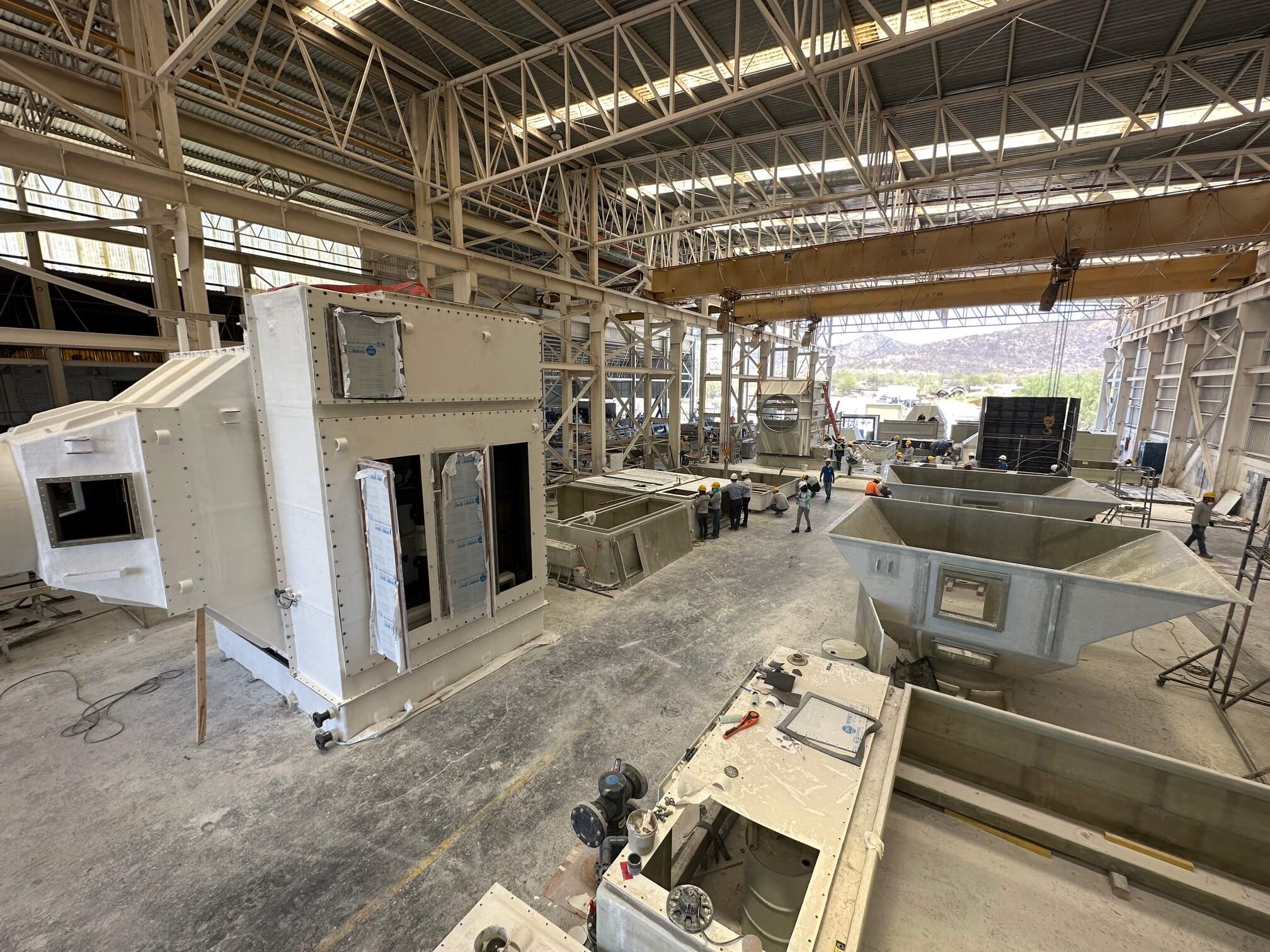
A buyer's guide to choosing the right resin system for FRP tanks and piping — resin families, chemical resistance testing, temperature limits, and what to specify before you order.
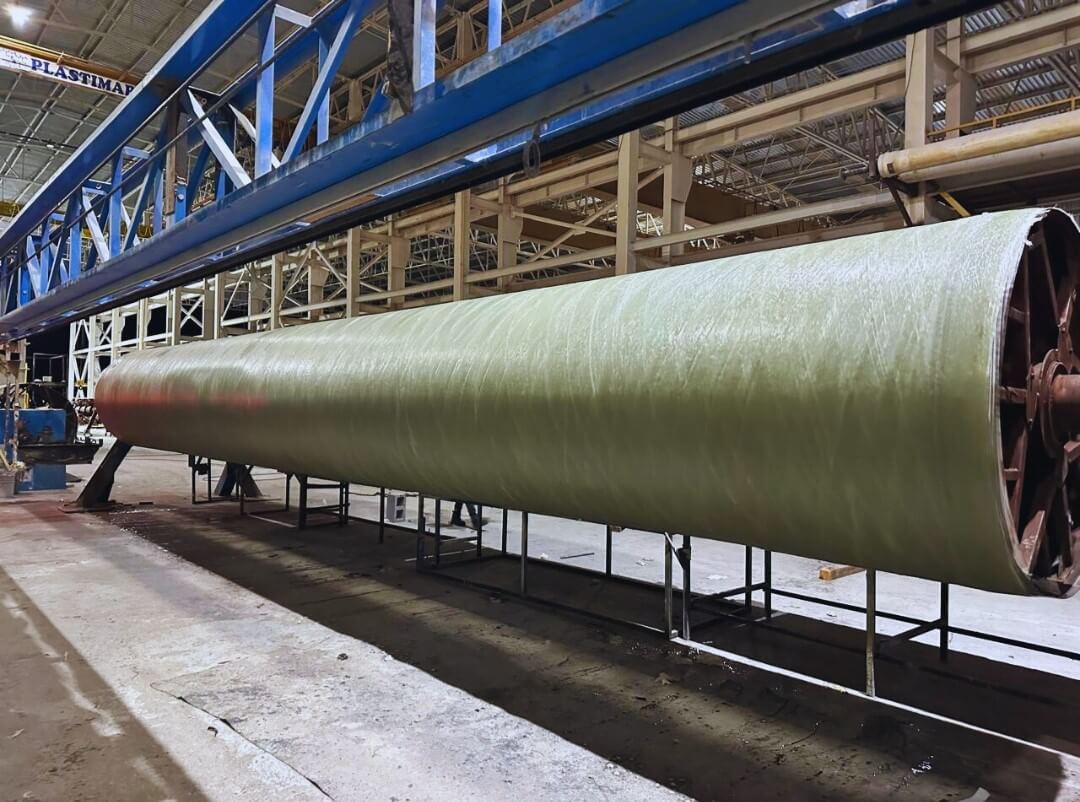
A buyer's guide to how FRP tanks are actually built — filament winding versus contact molding (hand lay-up) — and how each method affects structural performance, cost, and lead time.
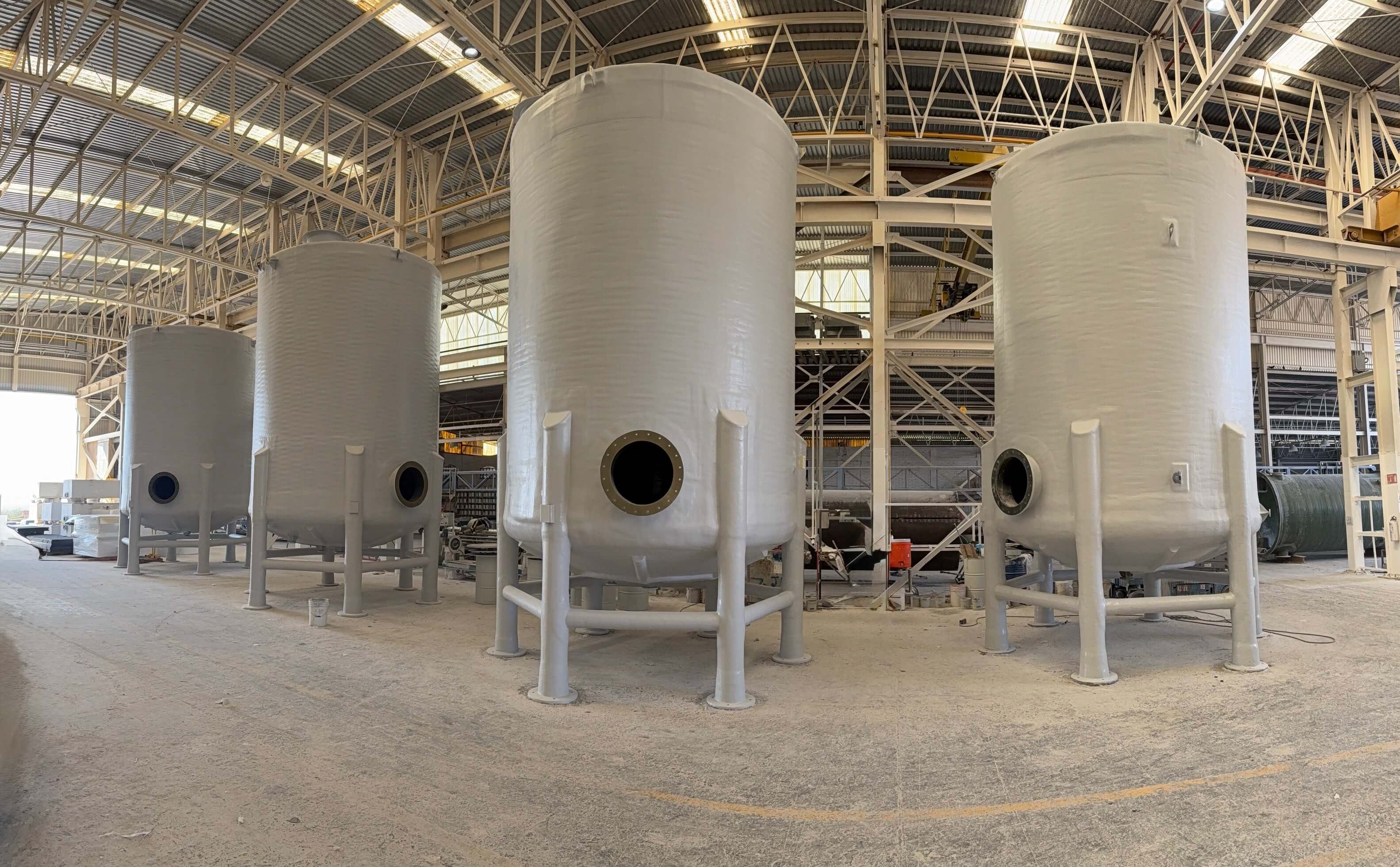
How to select FRP tanks and piping for hydrochloric acid service—resin systems, fluoropolymer liners, temperature limits, permeation, and the ASTM standards to specify.
Article Summary
A buyer's guide to inspecting FRP tanks in corrosive service — external and internal checks, Barcol hardness baselines, inspection intervals, and the ASTM standards that define acceptance criteria.
Need help with an FRP application?
Share your service conditions, chemical exposure, dimensions, or performance requirements and our team can help you evaluate the right FRP solution.
Request a Quote