

How to Read an FRP Tank Specification: A Buyer's Guide
A practical guide for buyers and engineers on how to read and evaluate an FRP tank technical specification — covering resin systems, fabrication methods, ASTM standards, and key design parameters.
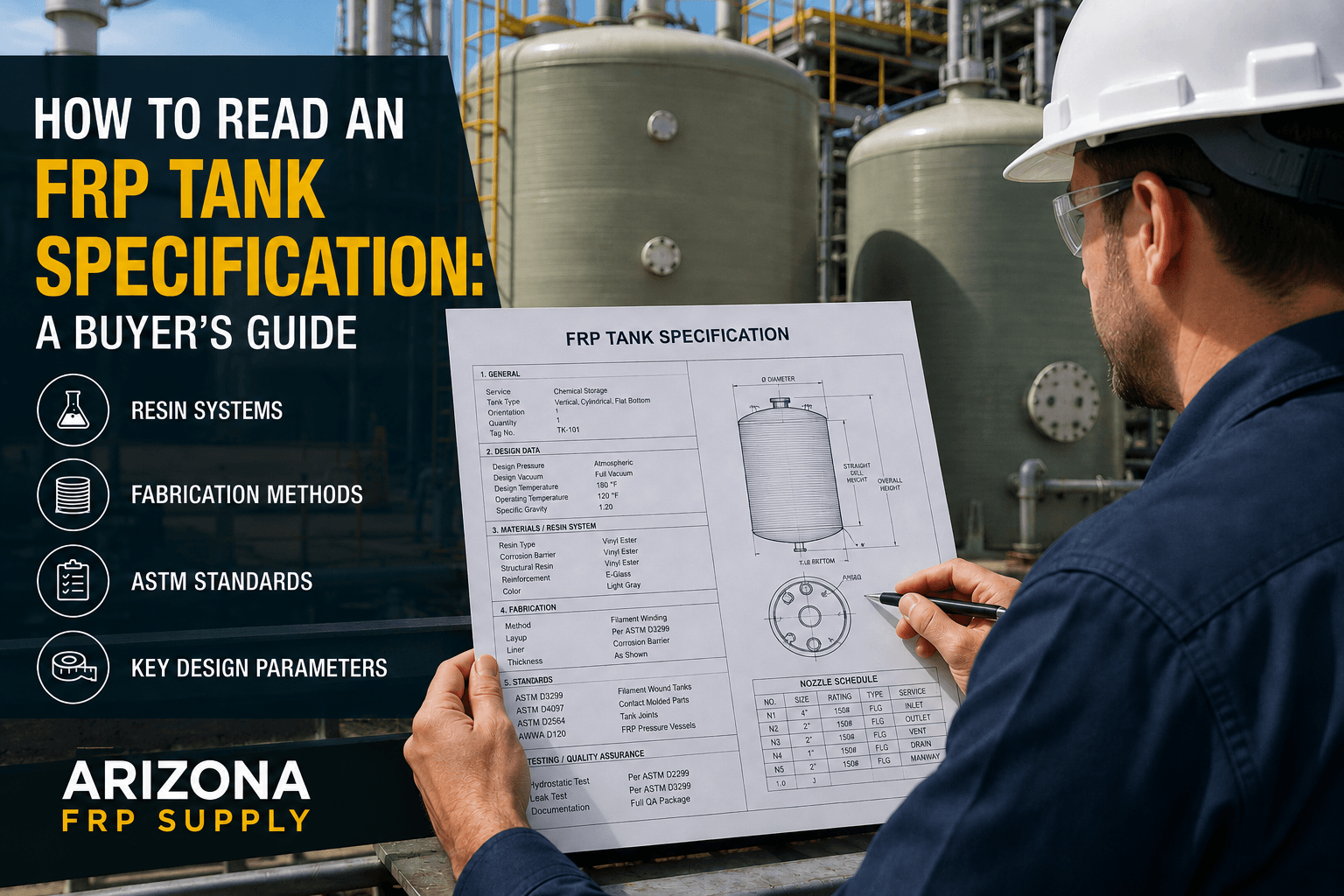
How to Read an FRP Tank Specification: A Buyer's Guide
Purchasing an FRP tank for chemical storage or industrial service is not like buying off-the-shelf equipment. Every tank specification is a technical document that defines exactly how the tank will be built, what it will resist, and how long it is expected to perform. Understanding what to look for in a specification — and what questions to ask — is the difference between a tank that performs for 25 years and one that fails in five. This guide walks through the key elements of an FRP tank specification so buyers and engineers can evaluate them with confidence.
1. Service Conditions
The first section of any FRP tank specification should define the service conditions — the actual operating environment the tank will face. This is the foundation of every design decision that follows. Key parameters to verify include:
- Chemical identity: the full chemical name and CAS number of the stored fluid — not just a trade name
- Concentration: minimum, maximum, and operating concentration expressed as a percentage by weight or volume
- Operating temperature: normal operating temperature and maximum excursion temperature
- Specific gravity: used to calculate hydrostatic load on the tank wall
- Operating pressure: atmospheric or pressurized service — this determines whether ASTM D3299/D4097 or a pressure vessel standard applies
If service conditions are missing or vague, the specification is incomplete. A reputable manufacturer will request this information before quoting.
2. Applicable ASTM Standards
A well-written FRP tank specification will explicitly reference the ASTM standards that govern its design and fabrication. The most important standards for atmospheric chemical storage tanks are:
- ASTM D3299 — covers filament-wound FRP tanks; defines minimum laminate requirements, dimensional tolerances, testing, and acceptance criteria
- ASTM D4097 — covers contact-molded FRP tanks; similar scope to D3299 but for hand-layup fabrication
- ASTM C581 — defines the test method for evaluating chemical resistance of thermosetting resin laminates; results confirm that the selected resin is compatible with the stored chemical
- ASTM D2583 — covers Barcol hardness testing of cured laminates; used to verify that the resin has achieved full cure before the tank enters service
If a specification does not reference any ASTM standard, ask which standard governs the design. Tanks built without a recognized standard have no baseline for quality or performance verification.
3. Resin System
The resin system is the most critical design variable in an FRP tank for chemical service. It determines chemical resistance, temperature limits, and long-term performance of the corrosion barrier. A complete specification will identify:
- Resin type: isophthalic polyester, vinyl ester, bisphenolic vinyl ester, or other — each with different chemical resistance profiles
- Corrosion liner resin: the resin used specifically in the interior chemical barrier layer, which may differ from the structural laminate resin
- Chemical compatibility basis: reference to ASTM C581 test data or a published chemical resistance guide that validates the resin selection for the specific chemical and concentration
Vinyl ester resins are typically specified for aggressive chemical service. Isophthalic polyester resins are suitable for less aggressive or dilute chemical applications. If the specification does not identify the resin system by type, request clarification before accepting the quote.
4. Fabrication Method
FRP tanks are manufactured by two primary methods, each with different structural characteristics. The specification should clearly state which method applies:
- Filament winding (ASTM D3299): continuous glass fiber rovings are wound under controlled tension onto a rotating mandrel; produces a highly uniform, high-strength laminate with consistent wall thickness — the preferred method for large-diameter tanks and aggressive chemical service
- Contact molding / hand layup (ASTM D4097): fiberglass reinforcement is applied by hand in layers with resin; allows greater geometric flexibility for custom shapes, heads, and fittings — commonly used for smaller tanks, complex geometries, and field fabrication
Both methods are valid when executed to their respective ASTM standards. The choice depends on tank size, geometry, chemical service, and structural requirements.
5. Laminate Structure
The laminate structure defines how the tank wall is built from the inside out. A complete specification will describe each layer:
- Interior surface veil: a thin resin-rich layer at the chemical contact surface — typically C-glass or synthetic veil — providing maximum chemical resistance
- Corrosion liner: the primary chemical barrier, typically 100–200 mils thick, consisting of chopped strand mat saturated with corrosion-resistant resin
- Structural laminate: the load-bearing wall behind the corrosion liner, designed to resist hydrostatic pressure, wind, seismic, and dead loads
- Exterior finish: UV-resistant topcoat or resin-rich layer for outdoor service protection
6. Key Dimensional and Structural Parameters
Beyond material selection, the specification should define the physical and structural design of the tank:
- Tank diameter and height or length
- Design capacity and maximum fill height
- Nozzle locations, sizes, and flange ratings
- Access manhole size and location
- Support configuration — flat bottom, legs, saddles, or lugs
- Wind and seismic design loads applicable to the installation site
7. Quality Control and Testing Requirements
A complete specification defines how the finished tank will be inspected and tested before delivery. Standard quality control requirements for FRP tanks include:
- Barcol hardness testing per ASTM D2583 to verify full resin cure
- Visual inspection of interior and exterior surfaces for voids, delamination, or dry fiber
- Dimensional verification of diameter, height, wall thickness, and nozzle locations
- Hydrostatic leak testing or vacuum box testing of seams and fittings
- Documentation package including material certifications, test reports, and fabrication records
Our Experience
With over 40 years of exclusive FRP manufacturing experience, Arizona FRP Supply has developed and reviewed hundreds of tank specifications for mining, chemical, and industrial clients across North America. Every tank we supply is custom-engineered to ASTM standards and fully documented — so buyers know exactly what they are getting before the first layer of fiberglass is applied.
Final Thoughts
An FRP tank specification is not a formality — it is the technical contract between the buyer and the manufacturer. Understanding its key elements allows buyers to ask the right questions, evaluate competing quotes on equal terms, and make material selection decisions with confidence. When in doubt, work with a manufacturer who can walk you through the specification line by line before the order is placed.
References
ASTM International. (2022). ASTM D3299: Standard specification for filament-wound glass-fiber-reinforced thermoset resin chemical-resistant tanks. ASTM International. https://www.astm.org/d3299-22.html
ASTM International. (2021). ASTM D4097: Standard specification for contact-molded glass-fiber-reinforced thermoset resin chemical-resistant tanks. ASTM International. https://www.astm.org/d4097-21.html
ASTM International. (2019). ASTM C581: Standard practice for determining chemical resistance of thermosetting resins used in glass-fiber-reinforced structures intended for liquid service. ASTM International. https://www.astm.org/c0581-03r19.html
Explore Related FRP Products
-
FRP Tanks
Custom FRP tanks for chemical storage, wastewater treatment and industrial fluid handling. -
FRP Pipes
Corrosion-resistant FRP pipes for industrial piping systems.
Related Articles

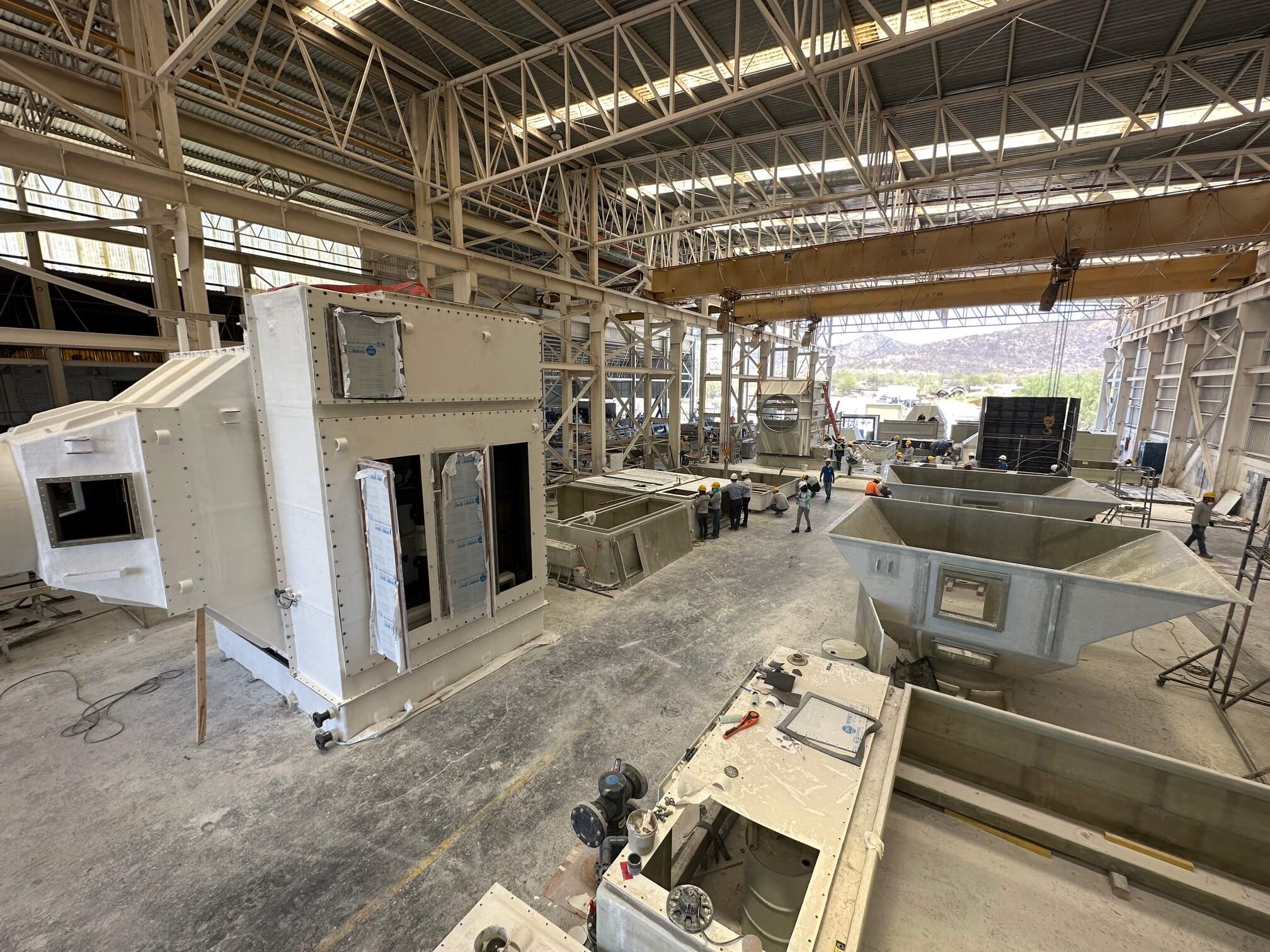
A buyer's guide to inspecting FRP tanks in corrosive service — external and internal checks, Barcol hardness baselines, inspection intervals, and the ASTM standards that define acceptance criteria.
A buyer's guide to choosing the right resin system for FRP tanks and piping — resin families, chemical resistance testing, temperature limits, and what to specify before you order.
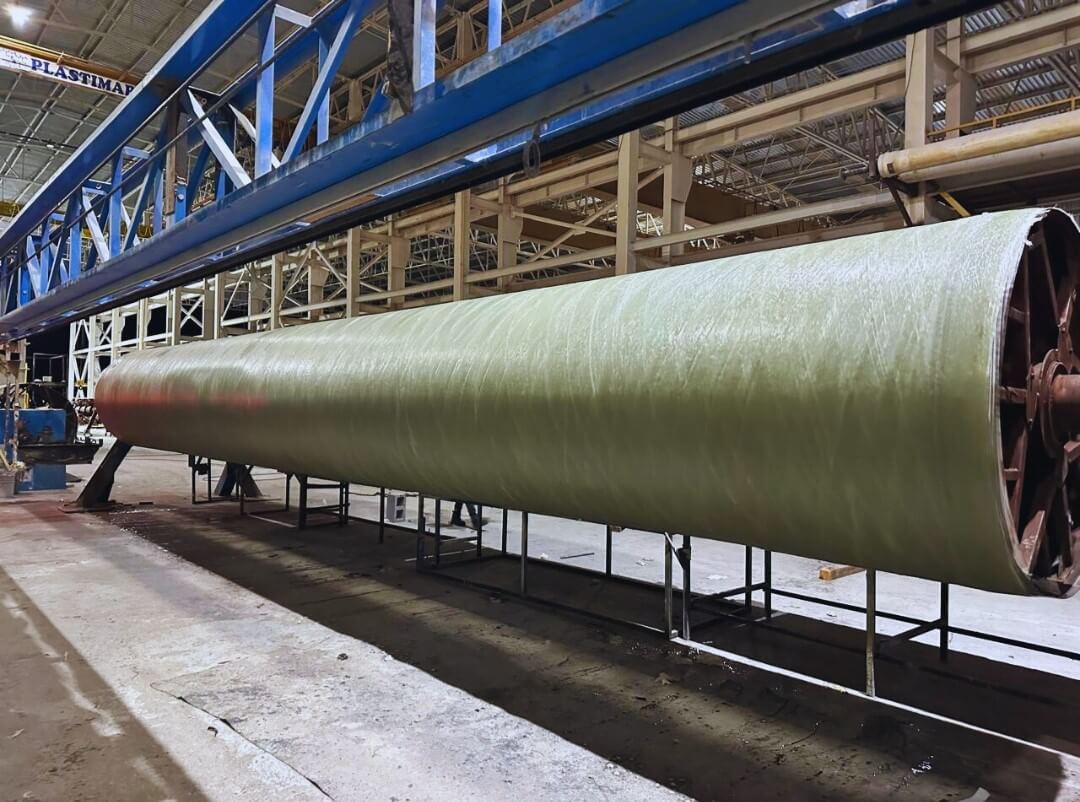
A buyer's guide to how FRP tanks are actually built — filament winding versus contact molding (hand lay-up) — and how each method affects structural performance, cost, and lead time.
Article Summary
A practical guide for buyers and engineers on how to read and evaluate an FRP tank technical specification — covering resin systems, fabrication methods, ASTM standards, and key design parameters.
Need help with an FRP application?
Share your service conditions, chemical exposure, dimensions, or performance requirements and our team can help you evaluate the right FRP solution.
Request a Quote