

FRP Scrubbers and Ductwork for Acid Fume Control
A buyer's guide to specifying FRP scrubbers and ductwork for acid fume control — condensate chemistry, resin and liner selection, the vacuum design case, and the ASTM standards to reference.
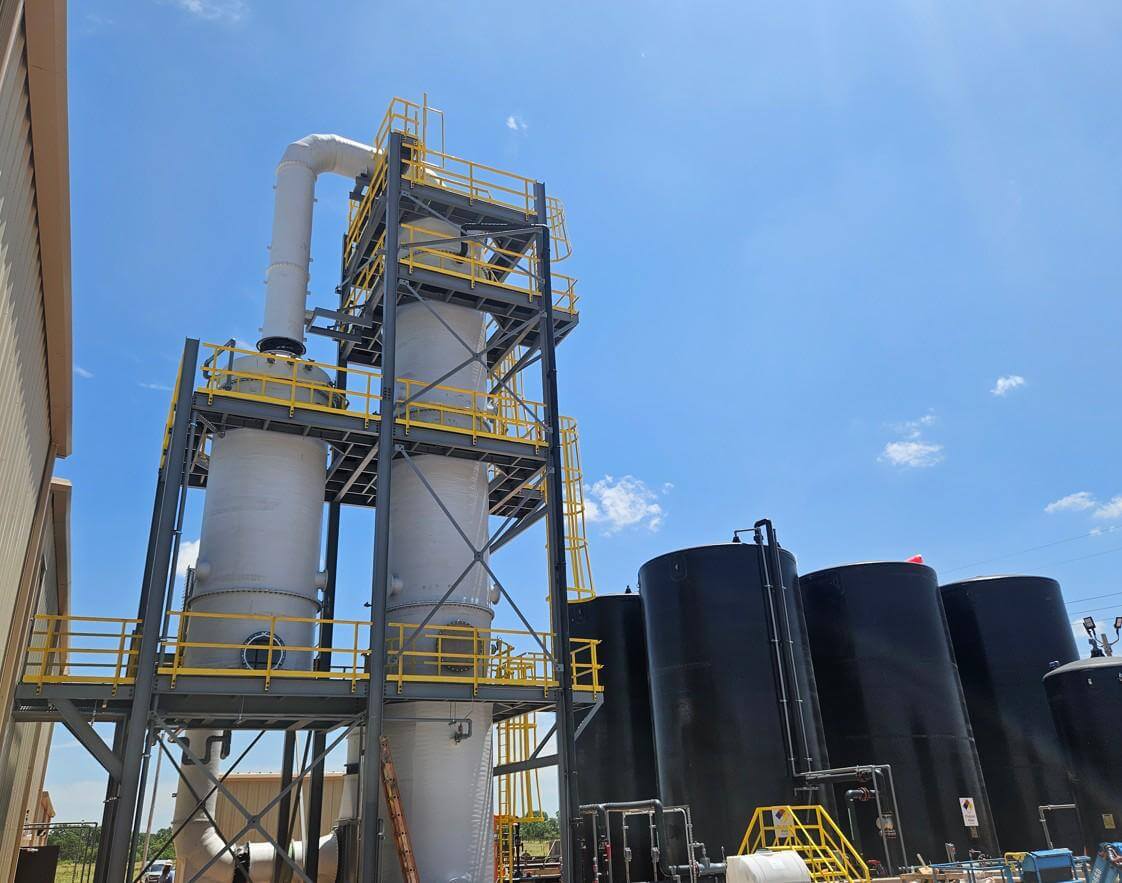
FRP Scrubbers and Ductwork for Acid Fume Control
A wet scrubber is the one piece of equipment in a plant that is deliberately fed the worst thing the process produces. Everything else handles a controlled stream; the fume control system handles whatever escapes. It sees acid mist, saturated vapor, temperature swings, carryover droplets, and condensate that forms and re-forms on every interior surface. That combination is why scrubber systems are one of the most common applications for fiberglass reinforced plastic, and also why a badly specified FRP scrubber fails faster than the tank sitting next to it.
This guide covers what actually drives the design of an FRP scrubber and its associated ductwork, what buyers should send a fabricator before asking for a price, and which ASTM standards to reference in the purchase specification.
The Gas Stream Is Not the Problem — the Condensate Is
Buyers usually describe a scrubber duty by naming the gas: hydrochloric acid fumes, sulfuric acid mist, chlorine, sulfur dioxide, nitric fumes from a pickling line. But dry gas at temperature is rarely what destroys the equipment. What destroys it is the liquid phase that condenses on the wall of the duct or the shell of the absorber.
That condensate is not the same chemistry as the process liquid. It is typically far more concentrated than the scrubbing liquor, it sits in a thin film against the laminate for long periods, and it concentrates further as the vessel cycles between operating and idle. A duct handling a modest fume concentration can develop wall condensate that is aggressive enough to attack a resin system that would handle the bulk liquid without difficulty.
The practical consequence: specify the corrosion barrier for the condensate, not for the average gas composition. If the condensate chemistry is not known, the fabricator needs to know the dew point, the operating and upset gas temperatures, and the concentration range of each acid species so the resin can be selected against a realistic worst case rather than a nominal one.
Where FRP Fits in a Fume Control System
A complete fume control train has several zones, and they do not all see the same duty:
- Collection hoods and inlet ductwork. Hottest, driest section. Temperature governs here, not chemistry.
- Quench or dilution section. Where hot gas meets liquid. Thermal shock, erosion, and the steepest temperature gradient in the system.
- Absorber shell and packing support. Fully wetted, continuous liquid contact, plus the dead weight of packing and hold-up liquid.
- Mist eliminator section and outlet duct. Saturated gas, continuous condensate film, and often the longest service life problem in the system because it is the least inspected.
- Stack. Wind load, thermal cycling, UV exposure, and condensate running back down the inside wall.
FRP is used across all of these zones, but the laminate is not the same in each one. A specification that calls out a single laminate schedule for the entire system is either over-building the dry sections or under-building the wetted ones. Ask the fabricator to break the laminate schedule out by zone.
Resin Selection: Temperature First, Chemistry Second
Resin selection for scrubbers follows a different order than for atmospheric storage tanks. With a tank, the chemistry is known and stable and temperature is usually modest. With a scrubber, temperature is the variable that most often exceeds what the buyer assumed.
Standard vinyl ester FRP laminates are generally suitable for continuous service in the range of roughly 180–200°F (82–93°C). Above that, the options are to cool the gas before it enters the FRP section, to move to a higher-temperature resin system, or to protect the laminate with a thermoplastic or fluoropolymer liner bonded to the FRP structural wall.
Where a fluoropolymer liner is warranted, the choice is driven by the continuous service temperature required. Published continuous service ranges for the common liner materials are:
- PFA: −310°F to 500°F (−190°C to 260°C)
- MFA: −310°F to 482°F (−190°C to 250°C)
- FEP: −310°F to 401°F (−190°C to 205°C)
- ECTFE: −105°F to 320°F (−76°C to 160°C)
- ETFE: −310°F to 311°F (−190°C to 155°C)
- PVDF: −40°F to 284°F (−40°C to 140°C)
A liner is not a default upgrade. It adds cost, lengthens lead time, and introduces bond-line and permeation considerations that a bare laminate does not have. It is the right answer when temperature, halogen acid permeation, or oxidizer strength puts the duty outside what the resin alone will hold.
Whatever resin is proposed, the supporting evidence should be chemical resistance data developed the way ASTM C581 describes — coupons of the actual resin system exposed to the actual reagent over time — rather than a generic compatibility chart. For liner materials, resistance to the reagent is evaluated under the practices in ASTM D543.
Vacuum Is the Design Case Most Buyers Forget
This is the single most common gap in scrubber inquiries. Fume control systems are almost always under negative pressure: the fan is downstream, pulling gas through the system. That means the duct and often the absorber shell are in vacuum service, and the governing failure mode is not corrosion at all — it is buckling.
A thin-wall FRP duct that is more than adequate for the chemistry will implode under a modest negative pressure if it was never designed for it, and it will do so instantly rather than progressively. The design response is wall thickness plus external stiffening rings at a calculated spacing, and both depend on the design vacuum, not the normal operating vacuum.
The design vacuum should be the pressure the fan can develop against a fully blocked or fully plugged system, not the normal operating differential. A packing bed that fouls, a mist eliminator that plugs, or a damper that closes unexpectedly can take a duct to full fan shut-off pressure in seconds. State that number in the inquiry. If nobody has calculated it, state the fan curve and let the fabricator work from it.
The same logic applies to support design. FRP duct is light empty and heavy when it is full of condensate and fouling. Support spacing, hanger design, and slope to drain points should be part of the scope discussion, not a field decision.
What to Specify When You Request a Quote
A scrubber inquiry that contains the following will get a real price and a real lead time rather than a placeholder:
- Gas flow rate, and whether it is stated at actual or standard conditions
- Full gas composition with concentration ranges for each corrosive species, including trace oxidizers
- Inlet gas temperature: normal, maximum, and upset
- Dew point and expected condensate chemistry, if known
- Design vacuum or fan shut-off pressure, and design internal pressure if any
- Scrubbing liquor chemistry, concentration, and temperature
- Packing type, depth, and wet operating weight, if the packing is specified by others
- Required removal efficiency, and the emission limit it is being held to
- Wind, seismic, and snow criteria for the installation site
- Duct routing, support points, and available slope for condensate drainage
- Nozzle and access requirements: inspection ports, manways, instrument connections, drain points
- Any flame spread requirement the installation must satisfy
- Exterior finish, UV protection, and whether a conductive or grounded interior surface is required
The last two get skipped frequently and cause the most change orders. Flame spread requirements in particular change the resin family available, so they need to appear in the inquiry and not in the approval drawing review.
Applicable ASTM Standards
For atmospheric and vacuum-service scrubbers and ductwork, the governing fabrication standards are the corrosion-resistant FRP equipment standards:
- ASTM D4097 covers contact-molded corrosion-resistant equipment. Most scrubber shells, hoods, transitions, hoppers, and fabricated fittings fall here, because the geometry is not a simple cylinder.
- ASTM D3299 covers filament-wound corrosion-resistant vessels. It applies to the cylindrical sections — absorber shells and straight duct runs — where winding gives better and more repeatable structural properties.
- ASTM C581 is the practice for developing chemical resistance data for the resin system in the intended service.
- ASTM D543 covers evaluating the resistance of plastics to chemical reagents, which is the relevant practice for liner material selection.
- ASTM D2583 covers Barcol hardness, the standard field and shop check that the laminate has cured properly.
Note what is not on this list: pressure vessel codes. A scrubber operating at atmospheric pressure or under fan-induced vacuum is not a pressure vessel, and specifying it as one adds cost without adding protection. Pressure vessel codes belong in the specification only when the equipment is genuinely designed for internal pressure.
Our Experience
We have been manufacturing FRP exclusively for more than 40 years, across more than 2,600 projects in mining, chemical processing, and water and wastewater treatment. Fume control systems have been a steady part of that work, and the pattern in the failures we are asked to replace is consistent: the resin was usually adequate, and the problem was somewhere else — an outlet duct with no drainage slope that held condensate against the wall, a stiffening ring layout designed for operating vacuum instead of shut-off vacuum, or a hot inlet that was never quenched to the temperature the laminate was built for.
We have also been applying fluoropolymer liners for more than 20 years, which gives us a practical view of when a liner earns its cost and when a properly selected bare laminate will do the same job for less. That conversation is worth having before the design is frozen, not after.
Final Thoughts
FRP is the right material for most acid fume control duty, and it has the service record to prove it. But a scrubber is a system, not a vessel, and the parts of it that fail are usually the parts nobody specified: the vacuum case, the drainage, the transition between temperature zones. Send the full gas and vacuum data with the inquiry, ask for a laminate schedule broken out by zone, and hold the fabricator to D4097, D3299, and C581 in the purchase order.
If you are specifying a new scrubber, replacing a duct run that has not lasted, or trying to work out whether your service needs a liner, send us the gas data and the fan curve. We will tell you what the laminate needs to be and what it does not.
Request a quote from Arizona FRP Supply
References
ASTM International. (2022). Standard practice for determining chemical resistance of thermosetting resins used in glass-fiber-reinforced structures intended for liquid service (ASTM C581-22). ASTM International.
ASTM International. (2023). Standard specification for filament-wound fiberglass-reinforced thermoset-resin corrosion-resistant tanks (ASTM D3299-16(2023)). ASTM International.
ASTM International. (2022). Standard specification for contact-molded glass-fiber-reinforced thermoset resin corrosion-resistant tanks (ASTM D4097-17(2022)). ASTM International.
ASTM International. (2021). Standard practices for evaluating the resistance of plastics to chemical reagents (ASTM D543-21). ASTM International.
Explore Related FRP Products
-
FRP Scrubbers
FRP scrubbers for industrial gas cleaning, odor control and corrosive fume treatment. -
FRP Tanks
Custom FRP tanks for chemical storage, wastewater treatment and industrial fluid handling. -
FRP Pipes
Corrosion-resistant FRP pipes for industrial piping systems.
Related Articles
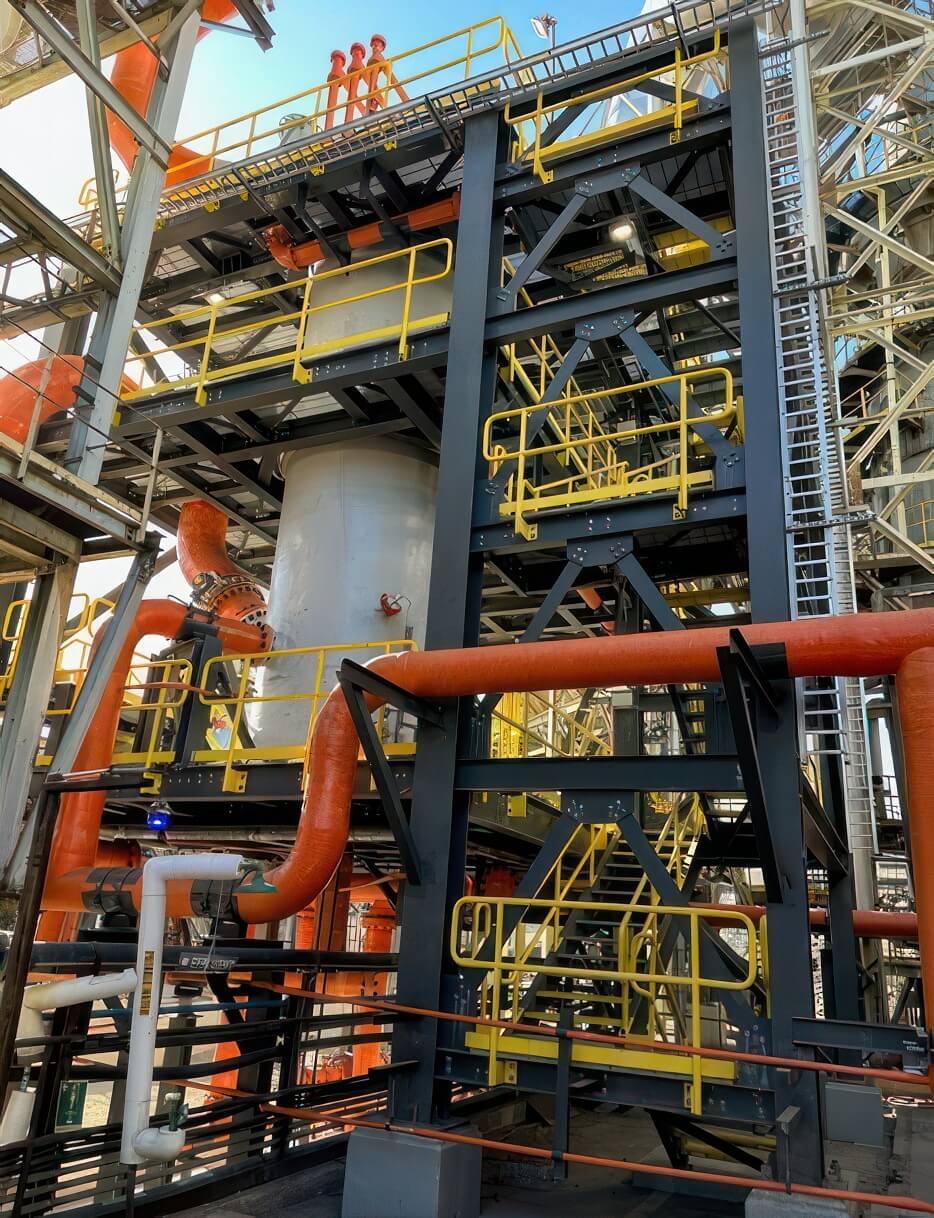
A buyer's guide to specifying FRP piping for corrosive chemical service — how pressure ratings are actually derived, corrosion barrier and resin selection, joining methods, thermal movement, and the ASTM standards to reference.
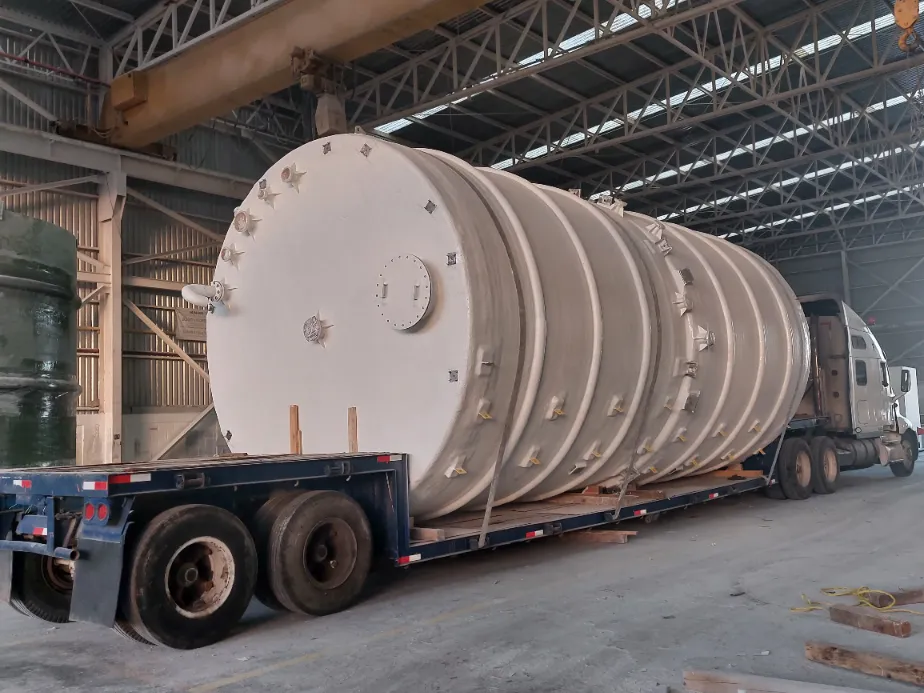
A technical guide to FRP tanks and piping systems lined with fluoropolymers (PVDF, ECTFE, FEP, PFA) for high-temperature corrosive chemical service in mining and chemical processing.
Article Summary
A buyer's guide to specifying FRP scrubbers and ductwork for acid fume control — condensate chemistry, resin and liner selection, the vacuum design case, and the ASTM standards to reference.
Need help with an FRP application?
Share your service conditions, chemical exposure, dimensions, or performance requirements and our team can help you evaluate the right FRP solution.
Request a Quote