

FRP Piping for Corrosive Chemical Service: A Buyer's Guide
A buyer's guide to specifying FRP piping for corrosive chemical service — how pressure ratings are actually derived, corrosion barrier and resin selection, joining methods, thermal movement, and the ASTM standards to reference.
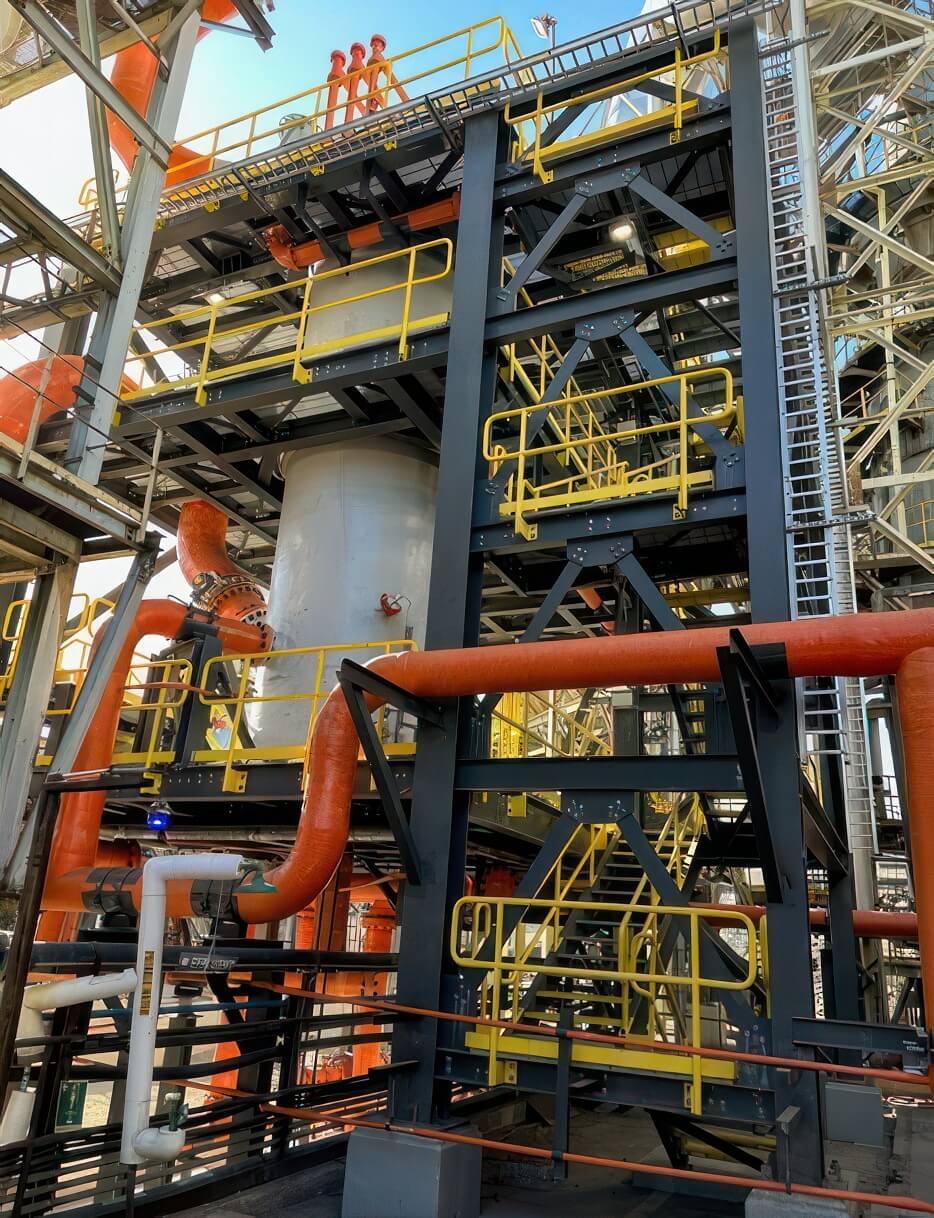
FRP Piping for Corrosive Chemical Service: A Buyer's Guide
Most corrosion-resistant piping failures are not resin failures. They are specification failures. The resin was selected correctly for the chemical, the pipe body performed as designed, and the system still leaked — at a joint, at a support, at a nozzle connection where thermal movement had nowhere to go.
FRP piping behaves differently from steel piping in ways that matter on the drawing board, not on the shop floor. It moves more with temperature. It is far less tolerant of point loads. Its pressure rating is not a single number but the output of a long-term regression test. Buyers who apply steel piping habits to an FRP bid package end up comparing quotations that are not comparable, and sometimes buying a system that will not survive its first thermal cycle.
This guide covers what actually drives performance and price in an FRP piping package for corrosive chemical service, and what to put in your inquiry so the quotes you receive can be evaluated side by side.
Pressure Rating Is a Test Result, Not a Wall Thickness
The single most misread line in an FRP piping specification is the pressure class. In steel piping, wall thickness and material grade give you an allowable pressure through a well-known formula. In FRP, the governing property is the hydrostatic design basis (HDB), established under ASTM D2992 by regression of long-term failure data — typically extrapolated to a 50-year service life — and then divided by a service design factor.
Two consequences follow directly:
- A pipe that passes a short-term burst test under ASTM D1599 has demonstrated nothing about its 50-year rating. Short-term burst is a production quality check, not a design basis.
- A quoted "pressure class" without a stated design factor and a referenced HDB is not a rating. Ask which design factor was applied. A supplier using an aggressive factor will always be cheaper, and the difference does not show up until year eight.
ASTM D2310 gives the classification system that makes this legible — type, grade, class, and stiffness — and ASTM D2996 covers filament-wound fiberglass pipe as a product specification. When your inquiry cites D2310 classification plus the D2992 design basis, every bidder is answering the same question.
For gravity, vent, and drain service, pressure class is largely irrelevant and stiffness governs instead. Buried or supported non-pressure lines fail by deflection and buckling, not by burst. Specifying a pressure class on a gravity line is a common and expensive habit carried over from steel.
The Corrosion Barrier Is the Part That Does the Work
Structurally, an FRP pipe wall is two components with two different jobs. The inner corrosion barrier — a resin-rich liner, typically a surfacing veil backed by chopped strand — is what contacts the chemical. The structural wall behind it carries pressure and load and is not designed for chemical exposure. Once the barrier is breached, the structural laminate wicks, and the failure propagates along the wall rather than staying local.
This is why resin selection has to be made against the actual service condition, not the chemical name. The variables that change the answer:
- Concentration. The same acid at two concentrations can call for two different resin systems, and in some cases the dilute condition is the more aggressive one.
- Operating temperature, including upsets. Standard vinyl ester FRP is generally suited to continuous service in the range of roughly 180–200 °F (82–93 °C). A line that normally runs at 120 °F but sees 190 °F during a wash cycle must be specified for the wash cycle.
- Oxidizers and solvent content. Trace oxidizers or organic solvents in an otherwise benign stream frequently drive the resin decision on their own.
- Velocity and solids. Abrasion thins the barrier from the inside. On slurry lines, the barrier thickness and any abrasion-resistant additions must be set against the real solids loading, not a generic allowance.
ASTM C581 is the practice used to evaluate a resin's chemical resistance in a laminate, and ASTM D543 covers the resistance of plastics to chemical reagents — the test basis behind a defensible resin recommendation. If a supplier recommends a resin without reference to either, ask what the recommendation is based on.
Where the chemistry exceeds what any thermoset resin will tolerate, the answer is a fluoropolymer-lined FRP construction: a thermoplastic barrier bonded into an FRP structural wall. Verified continuous service ranges vary widely by polymer — PVDF to 284 °F (140 °C), ECTFE to 320 °F (160 °C), FEP to 401 °F (205 °C), PFA to 500 °F (260 °C) — and the selection is driven as much by permeation resistance as by temperature.
Joints Are Where Systems Actually Fail
A piping system is a chain of joints connected by pipe. The pipe body is the part least likely to give you trouble. The three common joining methods carry very different risk profiles:
- Butt-and-wrap (laminated) joints. Made in the field by laminating over the joint. Strongest and most chemically continuous when done correctly, because the corrosion barrier can be carried across the joint. Entirely dependent on field workmanship, surface preparation, and cure conditions — which is exactly what degrades on a rushed shutdown.
- Bell-and-spigot adhesive joints. Fast, repeatable, and much less sensitive to crew skill. Limited by the adhesive's own chemical and temperature resistance, which is frequently narrower than the pipe's. Confirm the adhesive is rated for the same service as the laminate.
- Flanged joints. Necessary at equipment, valves, and anywhere the line must be broken for maintenance. Also the most commonly over-torqued component in an FRP system. FRP flanges require a full-face gasket, a controlled and staged bolt torque, and flat, parallel mating faces. Bolting an FRP flange to a warped steel counterflange and pulling it in with the bolts is a standard cause of cracked hubs.
Decide the joining method during specification, not during installation. It affects lead time, field labor, shutdown duration, and whether the system can be disassembled later.
Thermal Movement and Supports
FRP expands more than carbon steel over the same temperature change — how much more depends on the winding angle and the laminate sequence — but its modulus of elasticity is far lower. That means a restrained FRP line generates less load against a nozzle than an equivalent steel line would. The problem is not the magnitude of the force: it is that the laminate does not yield plastically. Steel absorbs a support error by deforming; FRP absorbs it by cracking, usually at the stiffest point in the system.
What this changes in design:
- Expansion loops, offsets, or expansion joints must be sized for the real temperature range, including ambient swings on outdoor runs in desert climates where day–night differentials are large.
- Anchors and guides have to be located deliberately, so the line expands toward the loop rather than into a nozzle.
- Supports must be continuous-bearing, not point contact. A steel-style support with a sharp edge under a thin-wall FRP line will score the laminate and start a crack.
- Support spacing is governed by pipe stiffness and contents density, and is generally closer than the equivalent steel line. Do not carry a steel support schedule onto an FRP drawing.
- Valves and heavy fittings need their own support. FRP pipe should not carry the dead weight of a valve.
What to Specify When You Request a Quote
An inquiry that includes the following will get you comparable quotations and a system that matches the service:
- Chemical, concentration range, pH, and any trace oxidizers or solvents
- Normal, maximum, and upset operating temperature — plus CIP or wash-cycle conditions
- Design pressure and whether the line is pressure or gravity service
- Full vacuum condition, if the line can be drained or steam-cleaned and allowed to cool
- Solids content, particle size, and design velocity for slurry lines
- Line sizes, lengths, fittings list, and a general arrangement or isometric
- Required joining method, or a request that the supplier recommend one
- Installation environment: buried, above ground, outdoor UV exposure, ambient temperature range, seismic requirements
- Applicable standards — D2996 and D2310 for the pipe, D2992 for the design basis, C581 for the resin
- Required documentation: laminate sequence, resin certifications, cure verification, hydrotest records
Applicable ASTM Standards
For FRP piping in corrosive chemical service, the standards that actually govern are narrow:
- ASTM D2996 — product specification for filament-wound fiberglass pipe
- ASTM D2310 — classification system for machine-made fiberglass pipe
- ASTM D2992 — practice for obtaining the hydrostatic design basis, the foundation of any long-term pressure rating
- ASTM D1599 — short-time hydraulic pressure resistance, used as a production verification
- ASTM C581 — chemical resistance of thermosetting resins in glass-fiber-reinforced structures
- ASTM D543 — resistance of plastics to chemical reagents
Note what is not on this list. ASME RTP-1 and ASME Section X apply to pressure vessels, not to piping, and citing them in a piping inquiry adds cost and confusion without adding assurance.
Our Experience
We have manufactured FRP exclusively for more than 40 years, across more than 2,600 industrial projects in mining, chemical processing, and water and wastewater treatment. More than 20 of those years have involved fluoropolymer-lined construction for services beyond the reach of conventional thermoset resins.
What that history keeps confirming: the piping systems that last are the ones where the service condition was defined honestly at the inquiry stage. The upset temperature nobody mentioned, the vacuum condition nobody flagged, the wash cycle that runs 60 degrees above normal operation — those are what shorten service life, far more often than the resin selection itself.
Final Thoughts
FRP piping is not a drop-in substitute for steel with a different price tag. It is a different engineering problem, with pressure ratings derived from long-term regression, joints that depend on method and workmanship, and thermal movement that has to be designed for rather than resisted. Get those three right and the system will outlast the equipment around it.
If you are specifying or replacing corrosive-service piping, send us the chemical, the temperature range including upsets, the design pressure, and a general arrangement. Arizona FRP Supply will review the service condition and come back with a resin recommendation, a joining method, and a quotation you can compare against any other on a like-for-like basis.
References
ASTM International. (2022). Standard practice for determining chemical resistance of thermosetting resins used in glass-fiber-reinforced structures intended for liquid service (ASTM C581-22). ASTM International.
ASTM International. (2018). Standard test method for resistance to short-time hydraulic pressure of plastic pipe, tubing, and fittings (ASTM D1599-18). ASTM International.
ASTM International. (2018). Standard classification for machine-made "fiberglass" (glass-fiber-reinforced thermosetting-resin) pipe (ASTM D2310-06(2018)). ASTM International.
ASTM International. (2018). Standard practice for obtaining hydrostatic or pressure design basis for "fiberglass" (glass-fiber-reinforced thermosetting-resin) pipe and fittings (ASTM D2992-12(2018)). ASTM International.
ASTM International. (2023). Standard specification for filament-wound "fiberglass" (glass-fiber-reinforced thermosetting-resin) pipe (ASTM D2996-01(2023)). ASTM International.
ASTM International. (2021). Standard practices for evaluating the resistance of plastics to chemical reagents (ASTM D543-21). ASTM International.
Explore Related FRP Products
-
FRP Pipes
Corrosion-resistant FRP pipes for industrial piping systems. -
FRP Flanges, Elbows & Tees
FRP flanges, elbows, tees and fittings for corrosion-resistant piping systems.
Related Articles
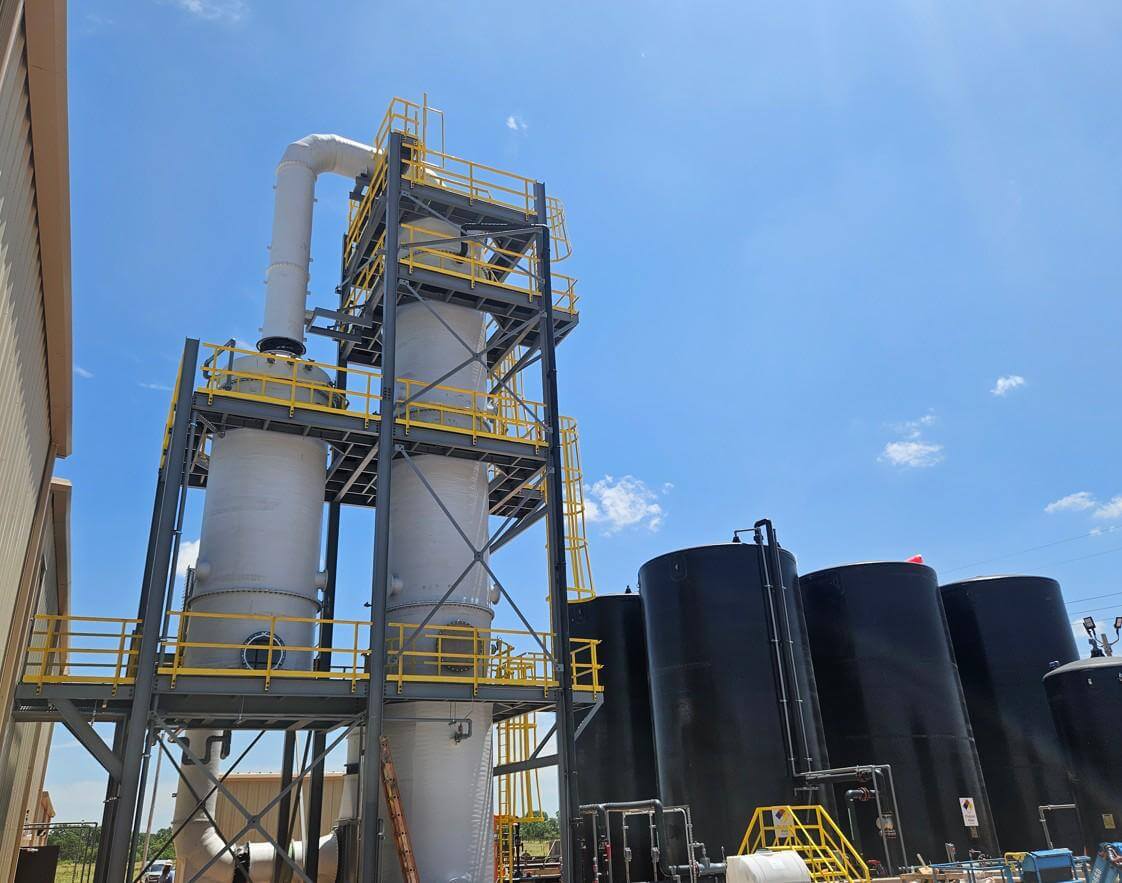
A buyer's guide to specifying FRP scrubbers and ductwork for acid fume control — condensate chemistry, resin and liner selection, the vacuum design case, and the ASTM standards to reference.
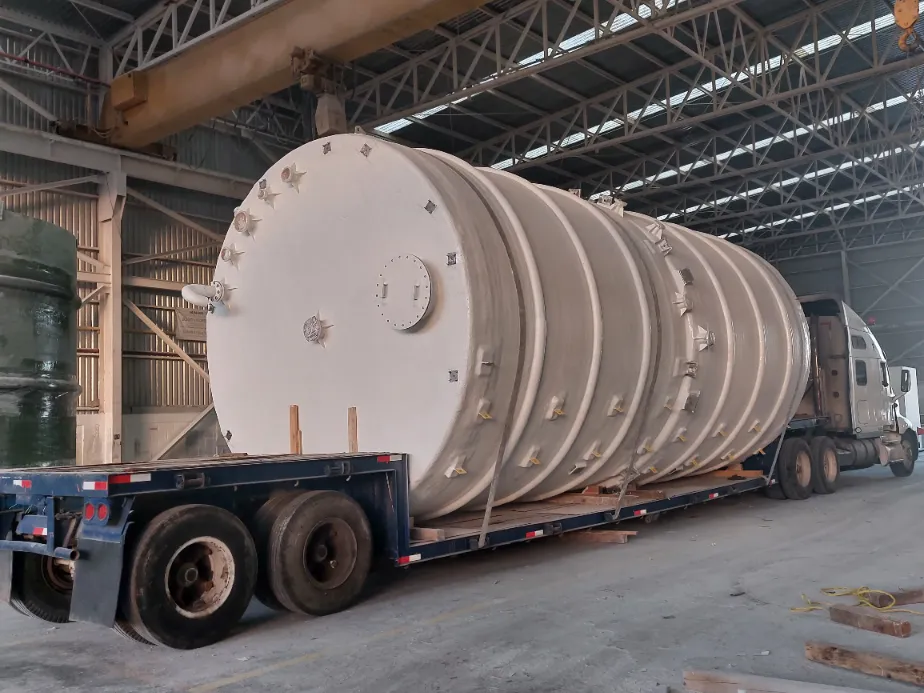
A technical guide to FRP tanks and piping systems lined with fluoropolymers (PVDF, ECTFE, FEP, PFA) for high-temperature corrosive chemical service in mining and chemical processing.
Article Summary
A buyer's guide to specifying FRP piping for corrosive chemical service — how pressure ratings are actually derived, corrosion barrier and resin selection, joining methods, thermal movement, and the ASTM standards to reference.
Need help with an FRP application?
Share your service conditions, chemical exposure, dimensions, or performance requirements and our team can help you evaluate the right FRP solution.
Request a Quote