

FRP Platforms and Walkways in Marine Environments
A buyer's guide to specifying FRP platforms, walkways, and structural profiles for coastal and marine service — chloride attack, resin selection, hardware, and the ASTM standards to reference.
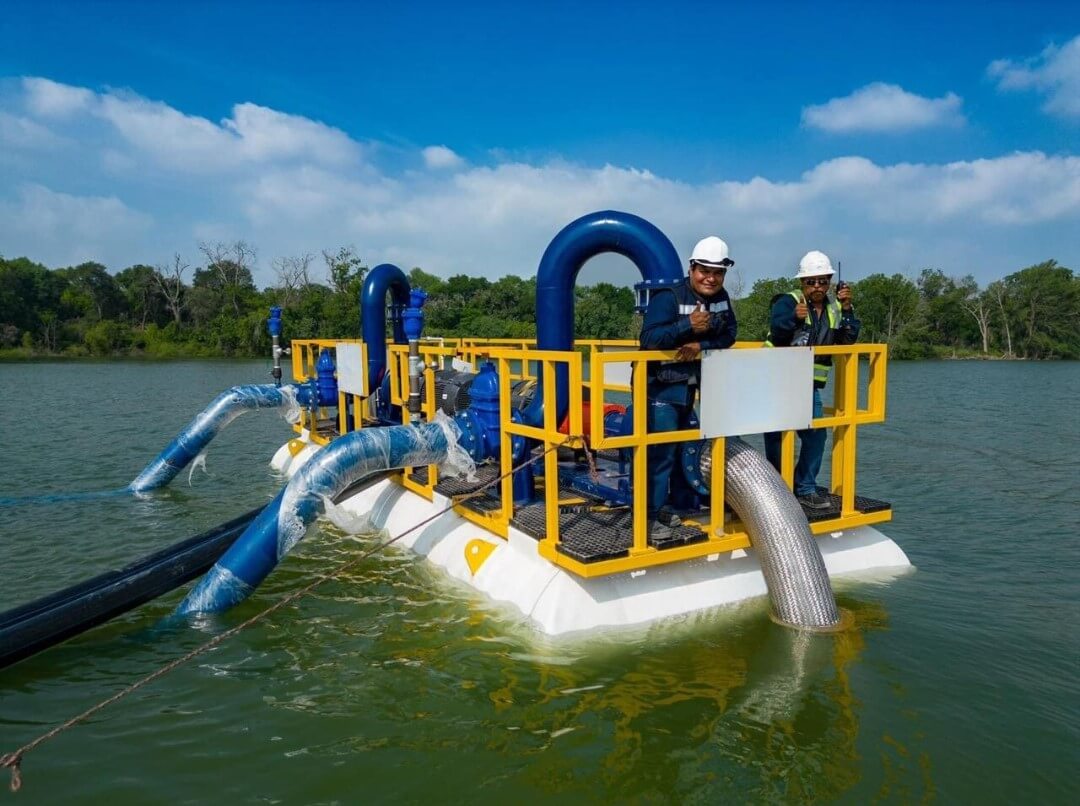
FRP Platforms and Walkways in Marine Environments
Coastal and marine installations are where structural materials get judged honestly. A desalination intake, a port loading dock, an offshore platform access route, a seawater cooling station, or a coastal wastewater outfall all share the same conditions: chloride-laden air, cyclical wetting and drying, continuous humidity, and direct ultraviolet exposure. Carbon steel structures in those locations depend entirely on a coating system, and stainless steel depends on a passive oxide film that chlorides are specifically good at breaking down. Fiberglass reinforced plastic (FRP) platforms, walkways, handrails, and structural profiles were developed to take that failure mechanism off the table. This guide covers what actually degrades a structure in marine service, where FRP performs well and where it needs to be specified carefully, and what to define before you place the order.
Why Marine and Coastal Service Is a Different Problem
Most corrosion guidance is written around a single aggressive chemical at a known concentration. Marine exposure is the opposite: a moderate electrolyte, present constantly, applied everywhere, and reconcentrated by evaporation. Seawater carries roughly 3.5% dissolved salts, with chloride as the dominant ion. That is not aggressive in the way concentrated acid is aggressive, but it is relentless, and it reaches surfaces that inspection programs rarely see — the underside of a walkway, the inside of a hollow support member, the faying surface between a grating panel and its support beam.
The splash and tidal zones are the most demanding areas of any marine structure. Surfaces there are alternately wet and dry, fully oxygenated, and repeatedly loaded with fresh chloride. For metallic structures, that combination accelerates every corrosion mechanism at once. For coating systems, it accelerates the mechanical damage that leads to coating breach. Any material decision for marine service should be made against the worst zone of the structure, not the average condition.
What Actually Attacks a Structure in Marine Service
Understanding the specific mechanisms makes it much easier to evaluate competing material proposals:
- Chloride-induced pitting and crevice corrosion in stainless steel, where the chloride ion locally breaks down the passive film and attack concentrates in a small area rather than spreading uniformly.
- Chloride stress corrosion cracking in austenitic stainless grades under sustained tensile load, which can propagate with very little visible surface loss.
- Progressive consumption of the zinc layer on galvanized steel, which is faster in marine atmospheres than inland ones, followed by direct rusting of the base steel once the coating is breached.
- Coating breakdown from ultraviolet exposure, thermal cycling, and mechanical damage during maintenance access, which reopens the corrosion pathway on painted carbon steel.
- Galvanic coupling between dissimilar metals — fasteners, clips, supports, adjacent equipment — accelerated by the high conductivity of a saline electrolyte.
- Crevice attack at bolted connections, faying surfaces, and under deposits, where oxygen depletion creates a locally aggressive chemistry.
- Biofouling and marine growth, which trap moisture against the surface and create differential aeration cells on metallic structures.
Why FRP Holds Up Where Coated Metals Don't
FRP is a non-metallic composite, so most of the mechanisms above have no pathway to act. There is no passive film to break down, no sacrificial coating to consume, no base metal underneath waiting to rust. Corrosion resistance is a property of the resin matrix distributed through the entire laminate, not a surface treatment with a finite life.
- Chlorides do not pit, crack, or dissolve a thermoset laminate the way they attack passivated metals, which eliminates the dominant marine failure mode.
- FRP is electrically non-conductive, so it does not act as an anode or cathode in a galvanic pair — relevant near cathodic protection systems, electrical rooms, or instrumentation.
- No repainting, recoating, or galvanizing renewal cycle is required to maintain corrosion resistance, which matters when the structure is difficult or expensive to access.
- The material is transparent to radio frequency and non-magnetic, useful near navigation, radar, or communications equipment.
- Lower weight than equivalent steel assemblies simplifies installation on remote or elevated coastal structures and reduces the load imposed on existing supports during retrofits.
- Slip resistance can be built into the surface — grit-top or molded concave-grit finishes — rather than applied as a coating that wears away in a wet, high-traffic area.
FRP is not indifferent to its environment, and it should not be sold that way. Ultraviolet exposure will affect an unprotected laminate surface over time, cut edges left unsealed can allow moisture to travel along exposed fibers, and the resin still has to be matched to any process chemistry the structure will see beyond seawater itself. All three are handled by specification, not by hope.
Resin, Reinforcement, and Surface Details for Coastal Exposure
For seawater and salt-spray exposure, corrosion-grade isophthalic polyester and vinyl ester resins are both established choices, with vinyl ester generally specified where the structure will also see process chemistry, acid mist, or elevated temperature. Standard corrosion-grade vinyl ester FRP is typically applied in continuous service up to approximately 180–200°F (82–93°C); in marine structural service, temperature is rarely the limiting factor, so resin selection is driven by chemical exposure and ultraviolet protection instead.
- A resin-rich surface layer with a synthetic or C-glass veil on the exposed face improves resistance at the surface where wetting and drying is most severe.
- Ultraviolet-stabilized resin formulations, pigment, and a protective topcoat should be specified for any structure in permanent outdoor service.
- Cut edges created during field fitting must be sealed with a compatible resin to prevent moisture from wicking along exposed glass — this is the single most common installation shortcut that shortens service life.
- Flame-retardant resin systems with a defined flame-spread classification should be specified where plant safety requirements or local code call for them.
- Drainage detailing matters: designs that let salt water pool on a horizontal surface or sit in a closed section will concentrate salts as the water evaporates.
Galvanic Corrosion and the Hardware Problem
An FRP platform assembled with the wrong hardware is still a marine corrosion problem — just a smaller one. Because FRP is dielectric, it does not participate in the galvanic cell, but the clips, bolts, washers, and support steel around it do. In a saline environment, the electrolyte is highly conductive, so dissimilar metal contact that would be tolerable inland can drive meaningful attack at the coast.
Practical measures are straightforward: specify a corrosion-resistant fastener metallurgy appropriate for chloride exposure, or use fully non-metallic hardware where load conditions allow; avoid mixing metals at a connection; and isolate FRP-to-steel interfaces with a non-conductive pad or bushing so that trapped moisture at the faying surface does not become a crevice cell against the supporting steelwork. Where FRP is retrofitted onto an existing coated steel structure, confirm that the connection detail does not damage the existing coating during installation.
What to Specify When You Order
A quotation is only comparable to another quotation when both are answering the same questions. For marine and coastal platforms, walkways, handrails, and structural profiles, define:
- Exposure zone: atmospheric salt spray, splash and tidal, or continuous immersion — these are not the same design case.
- Any process chemistry in addition to seawater, with concentration and temperature, since that usually governs resin selection.
- Design loads: uniform live load, concentrated load, and the deflection criterion the design must satisfy for pedestrian comfort and code compliance.
- Span direction, support spacing, and the panel or profile dimensions available at the site.
- Resin system and whether ultraviolet stabilization and a protective topcoat are included.
- Surface finish and slip resistance requirement for wet service.
- Flame-retardant classification, if required by the facility or the applicable code.
- Handrail, kickplate, ladder, and stair requirements, including the geometry the local code specifies.
- Fastener and clip metallurgy, and the isolation detail at every FRP-to-metal interface.
- Cut-outs and penetrations for piping, cable, and equipment, so panels are fabricated rather than field-modified where possible.
- Edge sealing procedure and the resin to be used for any field cuts.
- The ASTM standards that govern laminate construction and acceptance, along with the documentation package to be delivered.
Applicable ASTM Standards
Marine platforms, walkways, and custom structural fabrications are generally built by contact molding, so ASTM D4097 is the reference standard for laminate construction, workmanship, and acceptance criteria on contact-molded glass-fiber-reinforced thermoset components. Resin selection for the specific exposure — seawater alone or seawater plus process chemistry — should be supported by ASTM C581, the standard practice for determining the chemical resistance of thermosetting resins used in glass-fiber-reinforced structures intended for liquid service. Where you are comparing candidate resin systems against a defined reagent, ASTM D543 provides the practice for evaluating the resistance of plastics to chemical reagents, which is the appropriate reference for weighing one resin option against another under documented conditions.
Note that ASME RTP-1 and ASME Section X govern pressure-retaining equipment and are not the applicable standards for structural platforms and walkways. If a specification references them for a non-pressure structure, ask why.
Our Experience
In more than 40 years fabricating exclusively FRP, across 2,600+ completed projects, we've built platforms, walkways, handrails, structural profiles, and custom fabrications for mining, chemical processing, and water and wastewater facilities — including installations in coastal and high-chloride service where galvanized and painted steel had already been replaced once. What we consistently see is that the laminate itself is rarely the weak point. The problems come from unsealed field cuts, a hardware detail that reintroduced a galvanic pair, or a structure specified for an average exposure when one zone of it was sitting in continuous splash.
Final Thoughts
In marine and coastal service, the material question is not which structure looks strongest on day one — it is which one still meets its design criteria after a decade of chloride exposure without a recoating program. FRP removes the corrosion mechanism that drives most of that maintenance spending, provided the resin, ultraviolet protection, hardware, and edge details are specified deliberately. If you're evaluating platforms, walkways, handrails, or structural profiles for a coastal or marine installation, share your exposure zone, loads, spans, and any process chemistry, and we'll help you define the right laminate and connection details. Request a quote from Arizona FRP Supply.
References
ASTM International. (2020). Standard practice for determining chemical resistance of thermosetting resins used in glass-fiber-reinforced structures intended for liquid service (ASTM C581-20). ASTM International.
ASTM International. (2021). Standard practices for evaluating the resistance of plastics to chemical reagents (ASTM D543-21). ASTM International.
ASTM International. (2021). Standard specification for contact-molded glass-fiber-reinforced thermoset resin chemical-resistant tanks (ASTM D4097-21). ASTM International.
Explore Related FRP Products
-
FRP Platforms, Barges & Walkways
FRP platforms, barges and walkways for industrial and water-based applications. -
FRP Tanks
Custom FRP tanks for chemical storage, wastewater treatment and industrial fluid handling.
Related Articles
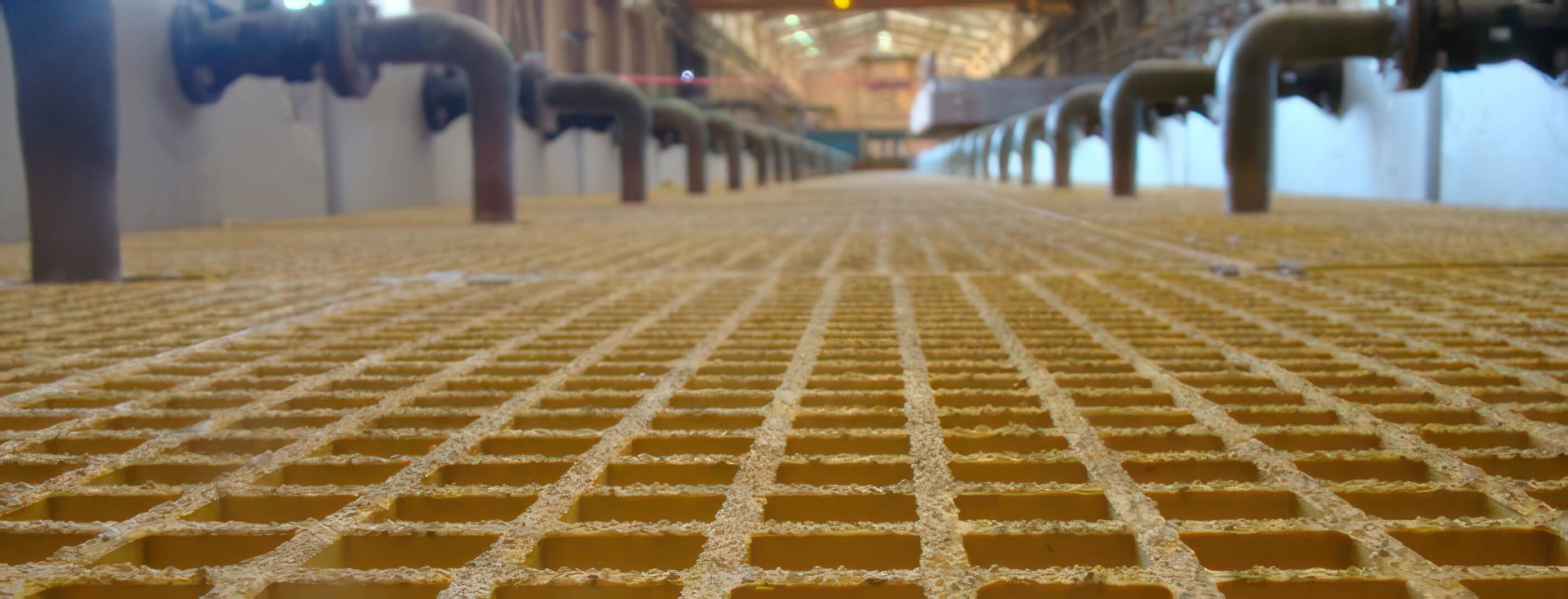
A buyer's comparison of FRP and galvanized steel gratings for corrosive plant environments — corrosion behavior, weight, maintenance, and what to specify before you order.
Article Summary
A buyer's guide to specifying FRP platforms, walkways, and structural profiles for coastal and marine service — chloride attack, resin selection, hardware, and the ASTM standards to reference.
Need help with an FRP application?
Share your service conditions, chemical exposure, dimensions, or performance requirements and our team can help you evaluate the right FRP solution.
Request a Quote